
PUDU · Commercial cleaning robots
PUDU MT1
Reference pudu-mt1
Designed to collect dust and debris in large spaces such as warehouses.
- Reference
- pudu-mt1
- Brand
- PUDU
- Category
- Commercial cleaning robots
- Model information
- Dry sweeping
- Debris bin
- 35 L.
- Sweeping width
- 70 cm.
- Rated coverage
- Up to 1,800 m²/h in standard mode.
Zoom, then drag to inspect a detail. Keyboard: +, −, arrows and 0.
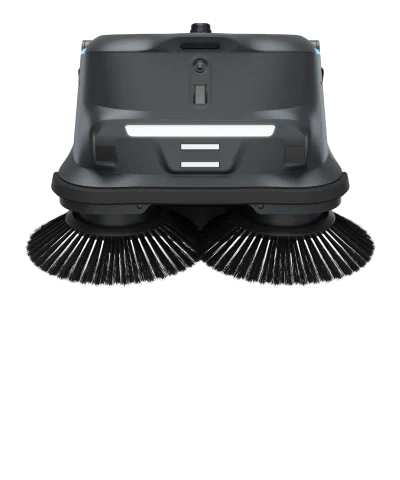
Product photograph. Zoom in for a closer look.
The product in detail
The PUDU MT1 is a dry sweeping robot for large spaces with two side brushes and a 35 L bin. The manufacturer describes visual debris recognition, targeted cleaning and vision plus LiDAR navigation. Dust control uses suction airflow and a filter; that function should not be treated as certification for every dust type.
Listed specifications
Supplier specifications. Performance varies with configuration and conditions of use. Follow the supplied product’s manual and label.
| Specification | Listed value or configuration |
|---|---|
| Practical width | 70 cm |
| Bin | 35 L |
| Maximum standard output | 1,800 m²/h |
| Listed spot-mode output | 6,000 m²/h |
| Runtime by level | 4–8 h |
| Listed charging time | < 3 h |
| Listed narrow passage | 75 cm |
| Dimensions L × W × H | 840 × 600 × 490 mm |
| Robot weight | 65 kg |
| Adjustable speed | 0.2–1.2 m/s |
Surfaces and compatibility
For automating a specific task on accessible routes validated on site. Check floors, debris, moving obstacles, thresholds and traffic schedules, then define exclusion zones.
The 6,000 m²/h figure refers to targeted cleaning and is not comparable to 1,800 m²/h standard sweeping. “24/7” operation includes charging and maintenance cycles rather than 24 continuous hours on one battery.
An auto-empty station and compatible waste box are available as options.
Preparation and use
- Survey the plan, widths, slopes and charging or parking locations.
- Select modules, brushes and any required water handling for the task.
- Map the site and validate routes under representative conditions.
- Assign responsibility for alerts, filling or emptying and manual intervention.
- Check cleaning quality and adjust missions using actual operation results.
Care and storage
Your team maintains sensors, brushes, filters, tanks or bins. Follow manual intervals and methods. Record alerts and include areas the robot cannot access in the overall cleaning routine.
Limits and things to check
Rated runtime and output depend on mode and test conditions. Charging, stations, obstacles and interventions reduce available cleaning time. Elevator or door connectivity requires a separate integration project.
Equipment, accessories and options
The auto-empty station and compatible waste box are paired options. Their dimensions differ from the robot’s and must be included in the room plan.
Practical questions
How do I check whether my site suits this robot?
For automating a specific task on accessible routes validated on site. Check floors, debris, moving obstacles, thresholds and traffic schedules, then define exclusion zones.
Are all accessories and consumables included?
The auto-empty station and compatible waste box are paired options. Their dimensions differ from the robot’s and must be included in the room plan.
What information is still needed before purchasing?
Specify filtration, permitted debris, station, door or elevator integration and local support.
Why might results differ from the listed output?
Figures describe different things: working path, theoretical or practical output, power and runtime by mode. Filling, emptying, charging, obstacles, consumable condition and technique influence actual work completed.